
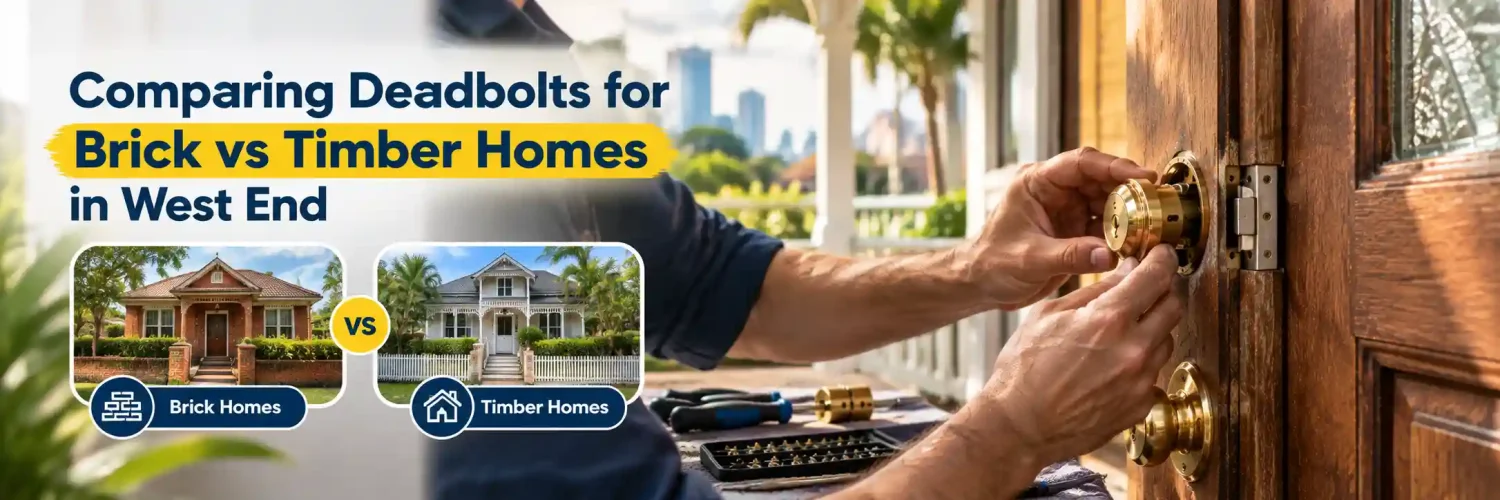
Walk down almost any West End street and you’ll see two very different types of home standing side by side: the classic timber Queenslander on stumps, and the low-set brick homes that were built in later decades. Between them you’ll find weatherboard workers’ cottages, converted warehouses along Montague Road, and newer townhouses filling old subdivisions. Each has its charm — but when it comes to fitting a deadbolt, they’re not the same job at all.
If you’re upgrading the front door on a heritage timber home near Boundary Street, or securing a solid brick post-war build closer to Highgate Hill, the right deadbolt for your neighbour’s house probably isn’t the right one for yours. And in West End specifically — where subtropical humidity, occasional storm weather, and character home heritage rules all come into play — a bit of thought upfront saves a lot of frustration later.
Why the door material matters
A deadbolt is only as strong as what it’s fitted to. In a brick home with a solid-core hardwood door and a masonry-anchored frame, the door itself is doing a lot of the work. The bolt drops into a strike plate that’s screwed through the jamb into brick. It’s hard to force, hard to kick in, and holds its shape year-round.
In a timber Queenslander, the door frame is usually pine or hoop pine mounted onto a stud wall. It’s a beautiful, breathable build — but it flexes. It shifts with humidity. It splits under a sustained kick if the strike plate is only held in with 20 mm screws. And after decades of Brisbane’s wet summers and dry winters, the timber has often absorbed and released moisture hundreds of times, leaving it softer around fixings than it was when the house was built.
Your deadbolt might be identical to your neighbour’s, but if the frame gives up first, the lock is irrelevant.
Deadbolts for timber Queenslander homes
For older West End timber homes, the goal isn’t just the lock itself — it’s the whole “door-in-frame” system.
Look for:
- A long-throw single or double-cylinder deadbolt. A bolt of at least 25 mm gives a stronger grip inside a timber jamb, and 30 mm+ is better still if the frame allows.
- A reinforced strike plate with 75 mm screws. The strike plate is often the weakest point. Longer screws catch the wall stud behind the frame, not just the trim.
- A separate deadbolt above the standard entry lock. Two independent locking points spread the impact of any forced entry.
- A double-cylinder version if your front door has glass panels, so someone can’t reach through a broken panel and turn the bolt from inside. Keep an internal key close by for fire safety.
- A door reinforcement plate wrapped around the door edge at lock height, particularly on older timber doors that may already have been drilled and re-drilled over the decades.
Timber doors also move. A deadbolt that fitted perfectly in May may bind in January. If yours suddenly won’t line up with the strike plate, that’s a sign the door has swollen, not a sign the lock has failed. Small seasonal shifts are normal, but if the door binds badly enough that you’re forcing the bolt, you’ll wear out the mechanism prematurely and eventually damage the frame.
Character homes with a heritage overlay have their own considerations. Some West End streets have restrictions on visible exterior changes to front doors. In practice this means original brass or bronze deadbolt escutcheons often need to stay — but the internal mechanism can usually be upgraded within the same visible footprint. A locksmith who knows character homes will match the aesthetic while modernising the actual security.
Deadbolts for brick homes
Brick homes in West End and the neighbouring suburbs often came with solid hardwood or engineered timber doors and a much heavier frame. This gives you more options.
Look for:
- Mortice deadlocks rebated into the door edge, rather than surface-mounted. They sit inside the door body, are harder to attack, and suit heavier doors.
- Higher-grade cylinders with anti-drill and anti-pick pins.
- Anti-jemmy plates covering the gap between door and frame, so a pry bar can’t get purchase between the door edge and the strike.
- Restricted key systems if you want tight control over who can duplicate keys — copies can only be made by the original locksmith with proper authorisation.
If your brick home has an aluminium security screen door on the outside (very common across Brisbane), a quality deadlock on the screen door plus a mortice deadbolt on the main door gives you two very different attack profiles for an intruder to defeat. This layered approach is one of the reasons brick homes are often perceived as more secure — not because brick itself is harder to break through, but because the door setup usually includes more independent locking points.
Australian Standards and lock ratings
In Australia, look for locks tested to AS 4145.2. The standard rates locks on things like security level, durability, and corrosion resistance. For a front door, a lock rated S6 or higher on security and D6 or higher on durability is a sensible baseline.
The rating system covers several attributes, each with numbered levels. You don’t need to memorise every code, but the security level (S) and durability (D) numbers are the two worth checking. A lock rated below S4 shouldn’t be on an external entry door.
Anything sold at a hardware store as a “budget deadbolt” without a visible Australian Standard mark should be treated with caution. It might do the job of a mechanical latch, but calling it security is generous.
Common Australian brands worth knowing
Not every good lock costs a fortune, but there are a few brands consistently recommended by Australian locksmiths:
- Lockwood — a long-standing Australian brand, particularly the 001 and 355 series deadlocks. Widely serviced and easy to get keys cut for.
- Gainsborough — solid mid-range options, common on newer builds.
- Whitco — the brand behind most Australian screen door locks. Reliable and inexpensive.
- ABUS — German-made, higher security, worth considering for high-value entries.
- Assa Abloy / Yale — global brands with a wide range of quality levels; make sure you’re buying from their commercial or upper residential range, not the budget lines.
Whatever brand you choose, the model matters more than the label on the box. Two locks from the same brand can be worlds apart in security.
Insurance and lock requirements
Something many Brisbane homeowners don’t check until it’s too late: most home and contents insurance policies have specific requirements for entry door locks. Common conditions include:
- A working keyed deadbolt on every external door
- Locks in working condition and actually used (a lock that “was installed” isn’t the same as a lock that “was engaged”)
- For sliding doors, an additional locking mechanism beyond the factory latch
If a claim is denied because a rear door didn’t have a compliant lock, no security upgrade elsewhere in the house will help. Read your policy’s security clause and match the hardware to it.
Signs your existing deadbolt should be replaced
Not every deadbolt lasts forever. Consider replacement if:
- The key is getting harder to turn, or you need to jiggle it.
- The bolt no longer throws fully into the strike plate.
- The lock body feels loose or wobbly when you turn the key.
- Any part of the cylinder has visible damage, drill marks, or corrosion.
- The lock is more than 25 years old and has never been serviced.
Deadbolts don’t usually fail catastrophically — they fail gradually. Small annoyances now often become a full lockout later, or worse, a lock that looks engaged but doesn’t actually secure the door.
In short
West End has one of the most mixed housing stocks in inner Brisbane, and there’s no single “best deadbolt” answer. On a timber Queenslander, prioritise long screws, reinforced strike plates, and a bolt long enough to bite into a moving frame. On a brick home, take advantage of the heavier door and consider a mortice deadlock. In both cases, the fitting is at least as
important as the hardware itself, the Australian Standard rating tells you whether the lock is actually up to the job, and your insurance policy quietly sets a minimum you don’t want to fall below.