
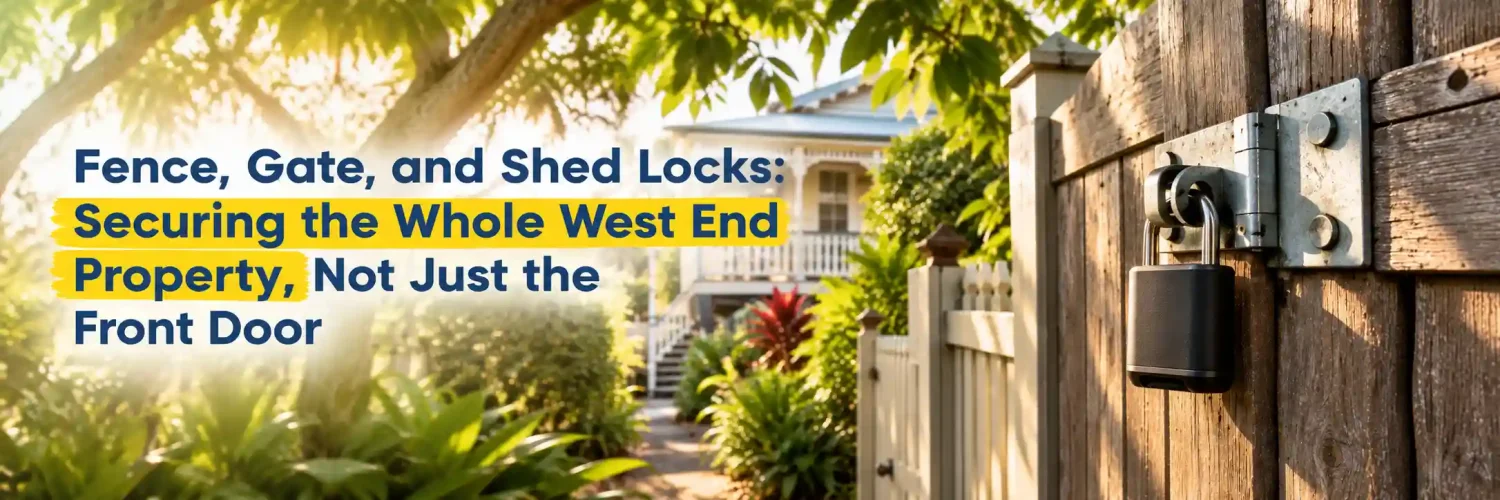
Ask most West End homeowners where their house is most secure, and they’ll point at the front door. Fair enough — that’s where the deadbolt is, the smart lock, maybe a security screen. But almost no serious intruder walks up the front path.
They come through the side gate.
The typical West End property — timber Queenslander on stumps, narrow block, a shared driveway or laneway on one side — has a security profile very different from a suburban new build. The front is well-lit and visible from the street. The back and sides often aren’t. And that’s usually where the weak point is.
The side gate: the actual first line of defence
Side gates on West End Queenslanders are often decades old, timber, and secured with a slide bolt or a padlock through a hasp. Common issues:
- The hasp is screwed into the timber with 15–20 mm screws that can be pulled with a claw hammer in seconds.
- The gate itself has dropped, so it doesn’t sit flush and can be lifted off its hinges.
- The padlock is a hardware-store special — brass body, thin shackle, easily cut.
- The latch is on the outside, so anyone can reach over and open it.
What to look for: - A hardened steel padlock with a shrouded shackle (so bolt cutters can’t get around it).
- A strong hasp bolted through the gate with carriage bolts, not wood screws, with the bolt heads on the outside and the nuts on the inside.
- Anti-lift hinge pins, or hinges installed so the gate can’t be lifted upward off its pivot.
- A height-appropriate gate — anything under 1.8 m is easily climbed.
- A latch on the inside face, with only a keyhole or a keyed padlock visible from outside.
If the existing timber gate is rotting or dropped, it’s often more cost-effective to rebuild than to keep upgrading the lock on a compromised structure. A gate that doesn’t close cleanly can’t be secured, regardless of what padlock you put on it.
Shed locks — where the tools live
For an intruder, your shed is more useful than your house. It’s where the tools that break into your house tend to be stored: crowbars, angle grinders, ladders, bike chains, even car spares. And in West End specifically, sheds also often contain expensive bikes, e-bikes, and scooters — commuting essentials that are also fast-moving stolen goods.
Most Colorbond sheds come with a plate-metal handle and a hasp that a decent multi-tool will defeat in under a minute. If your shed contains anything valuable — bikes, power tools, camping gear — it’s worth:
- Upgrading to a shrouded padlock rated at CEN grade 4 or above (or Australian equivalent).
- Adding a second locking point low down on the door.
- Anchoring bikes and expensive tools to a ground anchor or wall anchor inside the shed, so even if the shed is opened, the contents can’t just walk away.
- Removing hinge accessibility — some cheap sheds have exposed hinge pins on the outside.
- Installing a motion-activated alarm inside the shed — cheap standalone units run on batteries and add a real deterrent.
For high-value bikes specifically, the layered approach works best: shed lock, plus a ground anchor inside, plus a Sold Secure Gold-rated chain through the frame and wheel. Any one of those on its own is beatable. All three together turn a two-minute theft into a fifteen-minute one, which is usually enough to make the intruder move on.
Garage and roller door security
Colorbond roller doors on West End carports and garages have well-known weak points. The most common attacks involve:
- Lifting the bottom edge with a length of pipe or timber, especially on doors without a keyed lock.
- Attacking the emergency release cord through a gap at the top of the door.
- Cutting or drilling an inadequate side lock.
If your roller door is the main access to a garage that connects to the house — as it often is in low-set post-war homes — the door effectively becomes a front entry and should be secured accordingly. Options include garage door bolts on both sides of the door, an internal deadlock, and a shroud over the emergency release mechanism to prevent it being tripped from outside.
The front fence and pedestrian gate
West End front gates are often decorative, designed for kerb appeal rather than security. That’s fine — but don’t rely on them.
The real value of a front gate is behavioural: it slows people down, signals private property, and forces anyone approaching to make a deliberate decision. A latch and a simple padlock is usually enough. Skip the expensive lock here and put the budget into the side gate instead.
If your front fence has a rear laneway behind the property (common in older West End streets), the back gate is at least as important as the side. Laneways get less foot traffic and offer more cover for an intruder to work unnoticed.
Pool gates: safety and security overlap
Any pool in West End must comply with Queensland’s pool safety laws — self-closing, self-latching gates, minimum height, no climbable features nearby. These are safety requirements, not security ones, but they overlap. A pool gate that meets safety standards is also harder to open from outside, and the compliance inspections are worth using as a prompt to also check hinges, latches, and any padlock quality.
Sensor lights, cameras, and visibility
Locks are only part of the picture. On a typical West End block:
- Any dark corner around the side of the house should have a motion-sensor light.
- Any carport or under-house area should be lit — under-house voids in Queenslanders are a common weak point.
- Prune back hedges and vines that block sight lines from the street. Fig trees and jasmine climbing over the fence make beautiful photos and terrible security.
- Cameras don’t need to be expensive. A single well-positioned one covering the side gate and driveway is worth more than four cheap ones scattered around the house.
- Doorbell cameras are useful at the front, but a second camera covering the side approach is more valuable.
The order matters: lights come first (they deter), cameras second (they document), locks throughout. Cameras alone stop very little.
Under-house storage
Many West End Queenslanders have partially or fully enclosed under-house areas used for storage — bikes, tools, sports gear, camping equipment. These spaces are often secured with nothing more than a latticework panel and a slide bolt.
If yours is storing anything valuable:
- Upgrade any lattice access panel to a lockable framed door.
- Add a proper hasp and shrouded padlock rather than a slide bolt.
- Consider a motion sensor light inside the space that switches on when the door opens.
- Anchor bikes and expensive items to the stumps or floor joists — the enclosure keeps out casual eyes, but the anchor stops walk-off theft.
Weather considerations
Brisbane’s climate — humid summers, sudden storms, salt air near the river — is hard on outdoor hardware. Any outdoor lock should be:
- Rated for outdoor use (usually marked as weatherproof or having a specific IP rating).
- Made of stainless steel or hardened steel with a corrosion-resistant coating.
- Lubricated at least once a year with a graphite or PTFE lubricant, not WD-40 (which attracts dust and gums up over time).
A padlock that seizes in the rain is a padlock you’ll leave open next time. Rust is a security issue disguised as an inconvenience.
The whole-property mindset
Front-door security is a good start, but the real gains come from thinking about the property as a system: fences, gates, sheds, lighting, sight lines, and the flow an intruder would actually take. On a narrow West End block, closing off the side and back is usually the highest-value upgrade you can make.
A useful exercise: stand at the front kerb of your property and ask, “If I had to break in without being seen, where would I go?” Then walk that route. Whatever weak points you notice, an intruder will notice too. Address those first, before spending money on more front-door hardware you don’t need.