
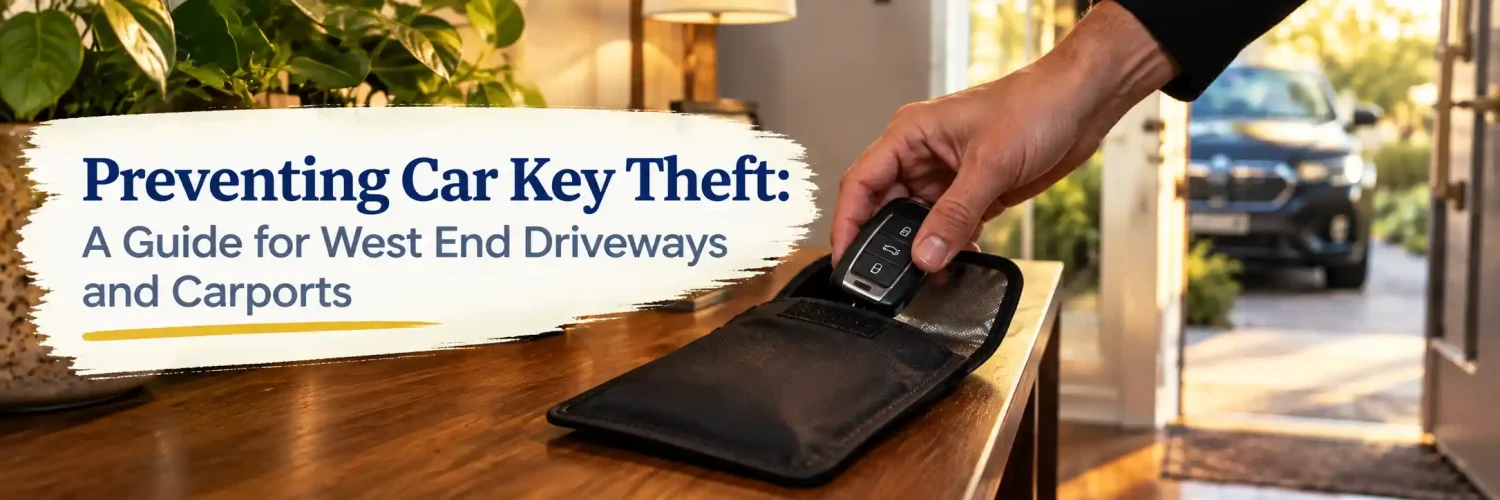
Car theft in inner-city Brisbane has shifted. It used to be about the car — hot-wiring, forcing a lock, breaking a window. Today, it’s overwhelmingly about the key. Modern vehicles are so hard to steal without their electronic key that thieves have adjusted: instead of attacking the car, they go for the key inside your house.
For West End, that’s a specific problem. The suburb has narrow blocks, on-street parking, short driveways next to timber Queenslanders, and open carports under high-set homes. Keys and fobs are often sitting on a hall table just a few metres from the vehicle — sometimes with only a flyscreen door between them and the street.
Here’s how to make yourself a much harder target.
Understand how modern car keys get stolen
There are three main methods:
1, Break-and-grab. A thief forces or slips a door open — often at night, often when they can see keys through a window. Grabs the keys, drives away. Takes under a minute.
2. Relay attack. For keyless-entry vehicles, thieves use a device to amplify the signal from your key fob inside the house out to the car parked in the driveway. The car thinks the key is present and unlocks. They drive off. Your key never left the hallway.
3. Opportunistic. Keys left in an unlocked car, in a jacket left in a shared laundry, on a shelf near an open window.
Each one has a different defence.
Understand your key type
Not all car keys are equally vulnerable, and knowing what type you have shapes the right response.
- Basic transponder key — physical key with a chip in the plastic head. Must be in the ignition to start. Not vulnerable to relay attack, but still valuable to a thief who can get near your car.
- Remote key with buttons — physical key plus a remote unlock button. Same risk profile as basic transponder, plus the risk of range extenders on the unlock signal.
- Proximity / keyless entry / smart key — no need to press anything; the car detects the key when you’re near. Highly convenient. Most vulnerable to relay attack.
- Digital / phone-as-key — newer luxury vehicles let you use a phone via Bluetooth or NFC. Different risk profile again, tied to your phone security rather than a physical fob.
If you’re not sure what type you have, check the owner’s manual or ask the dealer. The countermeasures are different.
Where you store your keys matters
- This is the single biggest change most West End households can make.
- Move keys away from the front door and any window. Ideally, keys should be stored somewhere deep inside the house, upstairs if possible, and away from any external wall facing the street or driveway.
- Never leave keys visible from outside. A glass front door with a key hook next to it is an advertisement.
- Consider a small key safe or lockbox inside a wardrobe. Doesn’t need to be complicated — just needs to add one more step.
- Don’t leave spare fobs in a nightstand near a bedroom window on the ground floor. Thieves have been known to fish keys through open windows with a magnet or hook on a stick.
Block the signal on keyless fobs
If your car uses proximity/keyless entry (the ones where you just walk up and the door unlocks), a signal-blocking pouch — sometimes sold as a Faraday pouch — is worth its weight in gold. It’s typically $10 to $30 and blocks the fob’s signal so a relay device can’t pick it up.
Points to remember:
- Both the primary and the spare fob should live in signal-blocking pouches.
- Test the pouch: put the fob inside, walk up to the car, try to unlock it. If the car unlocks, the pouch isn’t working.
- A metal biscuit tin works too, though a proper pouch is more convenient.
- The fridge is a myth — some do block signal, most don’t reliably.
- Any pouch will eventually wear out. Replace every couple of years.
Never hide a spare in or near the car
Under the wheel arch, in a magnetic box, in the boot behind a panel, in the glovebox — none of these are safe. If you can think of it, so can the person walking past your carport at 2 am.
If you need a spare accessible, leave it with a trusted neighbour or family member.
Secure the entry the keys sit behind
If a determined thief can walk through your flyscreen door in 30 seconds, upgrading your car alarm is beside the point. The lock on the door closest to your keys is doing more work than you think.
At a minimum:
- A working deadbolt on the front door.
- A security screen door that actually locks (not just latches).
- Motion-sensor lighting over the driveway, front path, and carport.
Break-and-grab attacks are opportunistic. The house that looks even slightly harder than its neighbours usually gets skipped.
Light the driveway and carport
Under a West End Queenslander, the carport is often the darkest spot on the property. Cheap solar sensor lights or a wired LED sensor light aimed at the parking spot make a big difference — both as a deterrent and as a way to see what’s going on if you hear something.
Motion sensor lights are more effective than dusk-to-dawn lights. A light that suddenly turns on is startling. A light that’s been on all night is background.
Motorcycles, scooters, and e-bikes
West End has an unusually high number of two-wheeled commuters. The security calculus for a motorbike, scooter, or e-bike is different — they’re lighter, easier to lift, and often stored more casually.
For motorcycles and scooters:
- A disc lock is a minimum. A disc lock with a motion alarm is better.
- Chain the bike to a fixed object where possible.
- Use a cover — even a cheap one — because a thief scanning a street for targets often skips whatever they can’t identify at a glance.
For e-bikes: - Bring the battery inside. A stolen e-bike with no battery is much less useful.
- Chain the frame and both wheels to a fixed anchor point.
- A GPS tracker embedded in the frame is worth considering for anything above $2000.
Ride-share and delivery vehicles
If you drive for a ride-share or delivery service, your car is on the road at odd hours and often parked in unfamiliar places. Standard advice still applies, but with two additions:
- Never leave the app open with your home address visible on screen when you park.
- If you’re switching between personal and work use, treat each stop as a “new location” for the purposes of thinking about visibility and lighting.
If your keys are stolen
Move fast:
- Report to police immediately. Get an event number.
- Contact your insurer. Some policies have time limits on notification.
- Get the vehicle rekeyed or reprogrammed. A locksmith can usually deactivate the stolen key from the car’s system so it no longer starts the vehicle, even if the physical key is found later.
- Rekey your home locks if the stolen keyring also had house keys on it — assume the thief knows your address (your rego is easy to trace).
- Cancel any transponders or access fobs for workplaces, apartment buildings, or other secure locations that were on the keyring.
Dealer vs auto locksmith for replacements
If you’ve lost your only key, you have two options:
Dealer — usually most expensive, requires proof of ownership, may involve towing the car to the dealership.
Auto locksmith — often faster and cheaper, can attend on site, capable of programming keys for most makes and models.
For older vehicles or basic transponder keys, a locksmith is almost always the better choice. For newer luxury vehicles with complex encrypted keys, check whether the locksmith has the programming equipment for your specific make.
The quick-win list
If you only do three things:
1. Move all car keys and fobs away from the front of the house.
2. Put keyless fobs in signal-blocking pouches.
3. Make sure the door closest to your keys has a working deadbolt.
These three shifts alone cover the vast majority of how modern vehicle thefts actually happen in inner-city Brisbane suburbs like West End. Everything else — lights, cameras, physical anti-theft devices, trackers — is refinement on top of that foundation.