
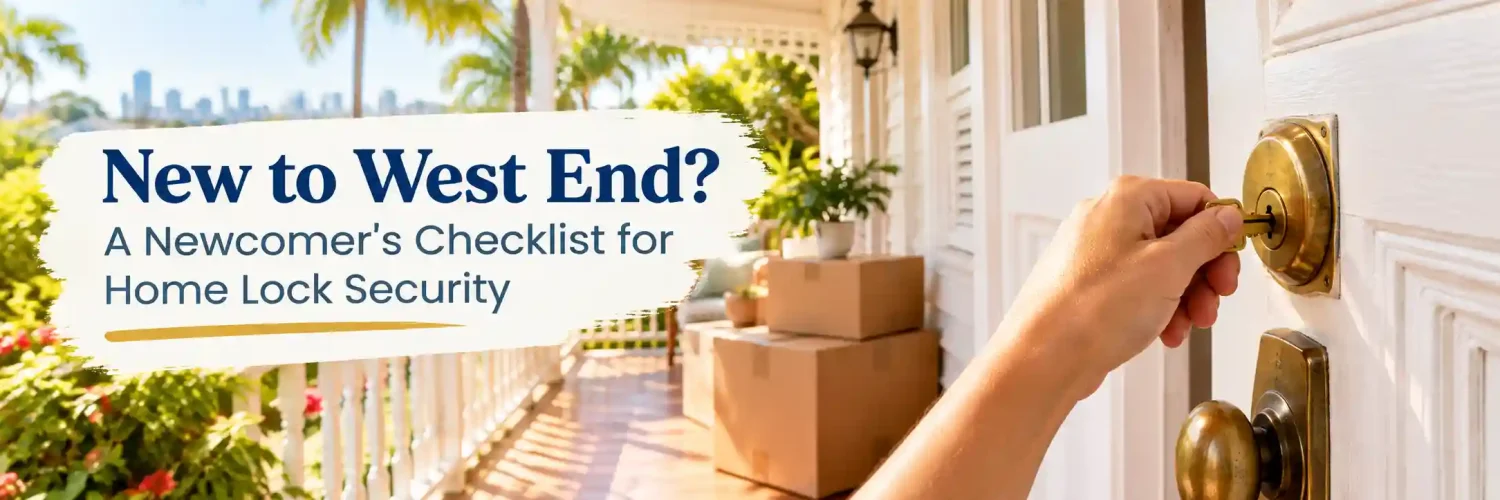
West End attracts a constant flow of new residents — students at nearby universities, interstate movers chasing the cafe scene, young families upgrading into a Queenslander, international arrivals landing at their first Brisbane home. Whether you’ve just signed a lease off Vulture Street or bought a place near Davies Park, one of the smartest first-week jobs is a full security walkthrough.
Here’s a checklist that works for both a rental and a purchase, tailored to the housing types you’ll actually encounter in West End.
Before you unpack: keys
Do a key audit on day one. Every key in your possession — front, back, laundry, side gate, mailbox, garage — should be identified and labelled. Then ask yourself: how many other people had a copy of these before me?
For a purchase, plan to have the locks rekeyed as soon as practical. Rekeying is much cheaper than replacing hardware, and it invalidates every key that came before you: previous owners, cleaners, tradies, agents, ex-partners. A West End rekey for a typical Queenslander with front, back, and laundry doors usually costs $150–250.
For a rental, ask the property manager in writing whether the property was rekeyed at the end of the last tenancy. If it wasn’t, request it. Under Queensland tenancy law, locks can only be changed by mutual agreement, in an emergency, or by QCAT order — so it needs to be negotiated, not done unilaterally.
For an apartment, keys aren’t the only access mechanism. You’ll usually also receive a building fob, a mailbox key, sometimes a car park remote or basement door swipe. Check that each of these was reissued or reprogrammed for you — a lost fob from a previous tenant is a way into the whole building, not just your unit.
Front door
- Is the deadbolt long enough to actually bite the strike plate when engaged?
- Are the strike plate screws at least 75 mm (long enough to catch the stud behind the frame)?
- If the door has glass panels, is the deadbolt double-cylinder so someone can’t break the glass and turn the bolt from inside? (Keep an internal key nearby for fire safety.)
- Is there a peephole or a way to identify visitors without opening the door?
- If there’s a security screen, does its lock actually work?
- Does the door itself have any rot, warping, or damage around the lock area?
Back door and laundry
The back door is the entry point people underestimate the most.
- Does it have an actual deadlock, not just a keyed doorknob?
- Is the frame in good condition? Timber Queenslander laundries in particular can have rot around the base of the frame.
- Are there external hinges? External hinge pins can be knocked out — anti-lift or non-removable pins fix this.
- If there’s a doggy door or old ventilation panel, can it be closed off or secured?
- Is the door itself solid, or a lightweight interior-grade door that’s been used externally?
Windows
West End is full of old timber sash windows and louvre windows, both of which have well-known weak points.
- Every window should have a working latch or lock — not painted over, not broken, not just closed with a nail.
- Louvre windows are difficult to secure well. If the room has them, consider security screens or window locks that hold the blades in place.
- Ground-floor and easily accessible upstairs windows (below verandah roofs, next to trees or awnings) matter most.
- Sash cord condition — old sash windows sometimes have broken cords replaced by a stick propping the window open. This is neither secure nor safe.
- Aluminium sliding windows should have a secondary lock or a track stop preventing the window being lifted out of the frame.
Side gates and fences
If your property has a side path or laneway access, this is often the most exploited route:
- Test the side gate latch and lock.
- Look at the hinges — can the gate be lifted off?
- Check that the fence itself doesn’t have a loose panel or missing paling.
- Is the gate tall enough that it can’t be easily climbed? 1.8 m is the sensible minimum.
- Is any latch reachable from outside by simply putting a hand over?
Shed, garage, carport
- Upgrade any hardware-store padlock on a shed to a shrouded, hardened lock.
- Anchor bikes and expensive tools to a wall or floor anchor inside the shed.
- If you have a remote garage door, reprogramme it so previous remotes no longer work.
- Check the emergency release on any roller door isn’t accessible from outside.
- Any keys hanging on hooks inside the shed (spare house key, car key)? Move them.
Under the house
- Many West End Queenslanders sit on stumps, with a partially or fully enclosed under-house area. Check:
- Are any lattice panels or gates that access the under-house area actually locked?
- Are any windows or doors from under the house into the main house floor secure?
- Is there electricity, meaning power tools might have been left down there?
- Are the stumps and floor joists accessible enough that anyone could climb through a floor vent?
Apartment-specific checks
If you’ve moved into one of West End’s apartment blocks, some different points apply:
- Building entry: Does the intercom work? Does buzzing someone in also unlock the lift or stairs?
- Common areas: Are car park exits, bin room doors, and side entrances all secured, or are they routinely propped open?
- Storage cages: If you have one in the basement, is the padlock adequate? These are commonly targeted.
- Balcony access: Can someone climb from a neighbouring balcony, an air-conditioning unit, or a stairwell? This matters on lower floors especially.
- Fire escape doors: They should open outward without a key from inside, but not open from outside without one.
Smart locks (optional)
If you’re considering a smart lock for the front door, the benefits are real — remote access for visitors, temporary codes for cleaners, no more hiding a spare key under a pot plant. But:
- Check compatibility with your existing door type before buying. Older Queenslander doors sometimes need modification.
- Choose a model with a physical key backup.
- Make sure the wifi and Bluetooth connection is stable in your specific spot.
- Renters: installing a smart lock counts as a structural change and requires written approval (RTA Form 23 in Queensland).
Emergency and spare keys
- Don’t hide a spare key outside. Anyone who’s watched a five-minute YouTube video knows the six common hiding spots.
- Give a spare to a trusted neighbour, friend, or family member rather than a rock in the garden.
- Save the number of a reliable local locksmith in your phone before you need one — a Sunday lockout is not the moment to start Googling.
- If you’re new to Brisbane, take the time to identify one before you need one. Emergency-only Google searches surface the most aggressively-advertised, not the most trustworthy.
Mail and parcel security
Not strictly a lock issue, but worth mentioning because it comes up constantly in West End:
- Check that your mailbox actually locks and that the key was included in the handover.
- If you order regularly online, consider a parcel drop box, a workplace delivery, or a locker service — West End has several parcel lockers around the area.
- Identity theft often starts with intercepted mail (bank cards, government notices). A working mailbox lock is a cheap fix.
Meeting the neighbours
- The single most effective and least advertised security measure: know the people around you.
- Introduce yourself to the immediate neighbours on both sides and across the street.
- Get one or two phone numbers or email addresses.
- Mention if you’re going away for more than a few days. A neighbour who notices unusual activity is worth more than a security camera nobody’s watching.
- Ask about the area’s rhythms — bin days, street cleaning, common issues.
Neighbourhood Watch is active in parts of inner Brisbane and worth joining if there’s a local group.
First-week priority list
If you do nothing else in your first week:
1. Get a rekey booked (or requested in writing, for a rental).
2. Fix or replace any broken window latches.
3. Upgrade the padlock on any side gate or shed.
4. Set up a spare-key plan that doesn’t involve hiding one outside.
5. Note your closest locksmith’s number in your phone.
Everything else can wait a fortnight. Those five cover most of the risk on a typical West End property, whether you’re in a Queenslander, a brick post-war home, or an apartment. The rest is refinement — better lighting, cameras, upgrades to specific hardware. Get the fundamentals right first, and the rest follows more logically once you’ve lived in the space for a few weeks and noticed how you actually use it.